The Bogotá-born DJ, producer and bandleader on building his own scenes, moving between worlds, and why home is something you carry
Some artists spend a career choosing between the decks and the studio. David Triana decided early on not to. He is a DJ, a producer, a songwriter and the bandleader of Triana y Hermana Juana, which blends Colombian and Caribbean rhythms with jazz and funk. For him it’s all one conversation, held in the same language.
That conversation started in Bogotá. As teenagers, he and Tomas Station launched Downpitch Recordings because the scene they were falling in love with online didn’t exist around them yet. So they built it, writing and pressing their own records and throwing their own parties. The same instinct followed him through residencies in Bogotá, Madrid, Istanbul and London, and into Soursopp in London. It traces back to something older still: the punk rock scene he came up in before he ever wrote a dance track.
We caught up with David to talk about where he is creatively, what a DIY upbringing leaves behind, and what “home” means after more than a decade in London. Wanting to start with the big picture, we discuss where David is creatively right now, and what he was most excited about making at the moment, “This is a great moment for me as a creator, because I dreamed for many years of being able to play both as a DJ and as a musician, and to also produce and write songs. At times, people and friends questioned me about how I could make this work, and for me, this was always a question of how to integrate my skills into a conversation through the same language — this is music we are talking about.
He continues to explain his deeper connection to music, “Music is a language that is there to help people connect with their most personal and deepest feelings, and through that inner exploration you can reach others and find the most magical common ground of what feelings in our life experience can be like. So, at this moment, I feel great because, after years of showing up again after each failed trial and trying to do what I do, I feel that I’m standing on better ground and also finding better channels and spaces to share my music, whether it’s the band or my club sound.
And what I’m most excited about at the moment is delivering more music from my projects. I’m working on several records at the moment, material for the dance floor and also for the band. This is where everything gets even better. The more you produce, the more you write, the more experience you acquire. That, for me, is the most important thing: to perfect my artistry and my passion, which is centred on creating itself. And that can be a song, or it can be a DJ set, or a live music performance. So it’s all connected. It has always been, and that is why it was possible to make it happen.”
Returning to the discussion about Downpitch Recordings with Tomas Station, David explains what those early years taught him that still shows up in how he runs things today, “Well, what these early years taught me was essential to how things developed afterwards. What we did at that time was create the environment that we didn’t have access to. We were teenagers falling in love with dance music, and we really didn’t have a scene that we could be part of. I’m sure there were things happening here and there in Bogotá and Colombia, but they were not directly connected to the artists and sounds that we were discovering on the internet, happening all around the world.
David continues to explain, “So at the time, we decided to write our own music, press our own music, and even promote and create parties so that we could share this with a few friends. And it all started from scratch.” He draws comparisons to later projects with the same enthusiasm, “Years later, this process started over and over again many times. Later, for me, for example, in London with Soursopp. But it was the same intention: whatever wasn’t possible for me to just break through into, I would create my own opportunities and invite others to experience them.
It’s a DIY ethos that has always stayed with me. Even before I was writing dance music, I was part of the punk rock scene, and that’s something that really stayed with me. You can always do it yourself and invite others into that process. Not because it’s cooler, but because sometimes that’s the only way. Other times you have opportunities to join others, but if that’s not the case, you always have the option to generate your own.”
Downpitch brought international names like Anthony Naples and Jimmy Edgar into Bogotá’s scene early on. Looking back, we asked what did these parties and bookings do for the city’s relationship with electronic music, “I like to believe that it brought the chance for new music and new experiences to people from the city, and that it added to the diversity of nightlife that we had over there at the time. I think it did. Sometimes I’m lucky enough that people approach me back home and thank us, and me, for what we’ve done throughout the years with our parties and our music.
I think that people in my city are amazing and nowadays very open-minded and grateful for those who try to do things differently. Having had the chance to evolve there, while also bringing artists and sounds from other places and throwing parties, definitely showed the direction in which the city’s culture was slowly moving. Now Bogotá is home to huge music festivals and lots of successful artists who travel worldwide and made it all happen from there.”
Alongside Rakim Under, David has organised Soursopp parties in London and other cities throughout his career. We wanted to learn what David felt was missing from the scenes he was involved with at that time. David explains that it was perhaps not a case of what was missing, “It was more that we had a lot of friends who knew about our passion for music and had experienced our music in environments like house parties, or maybe smaller parties where we were already playing, in London and other cities around Europe and South America.
That gave us the idea of creating a party where we could welcome people in the best possible way, hosting old and new friends to share moments on the dance floor. And that’s something that we love: thinking about a new space, thinking about the sound system, how to set up the whole thing, and how to re-create this unique moment in our own way.
David is also realistic in his assessment of his parties, “Not all parties are the same. There are a lot of little details that can change that experience a lot. So again, I don’t think that what drove us there was anything missing. There are so many amazing communities and parties. We just saw the opportunity to create our own because there was some curiosity around us, which gave us the strength to give it a go.”
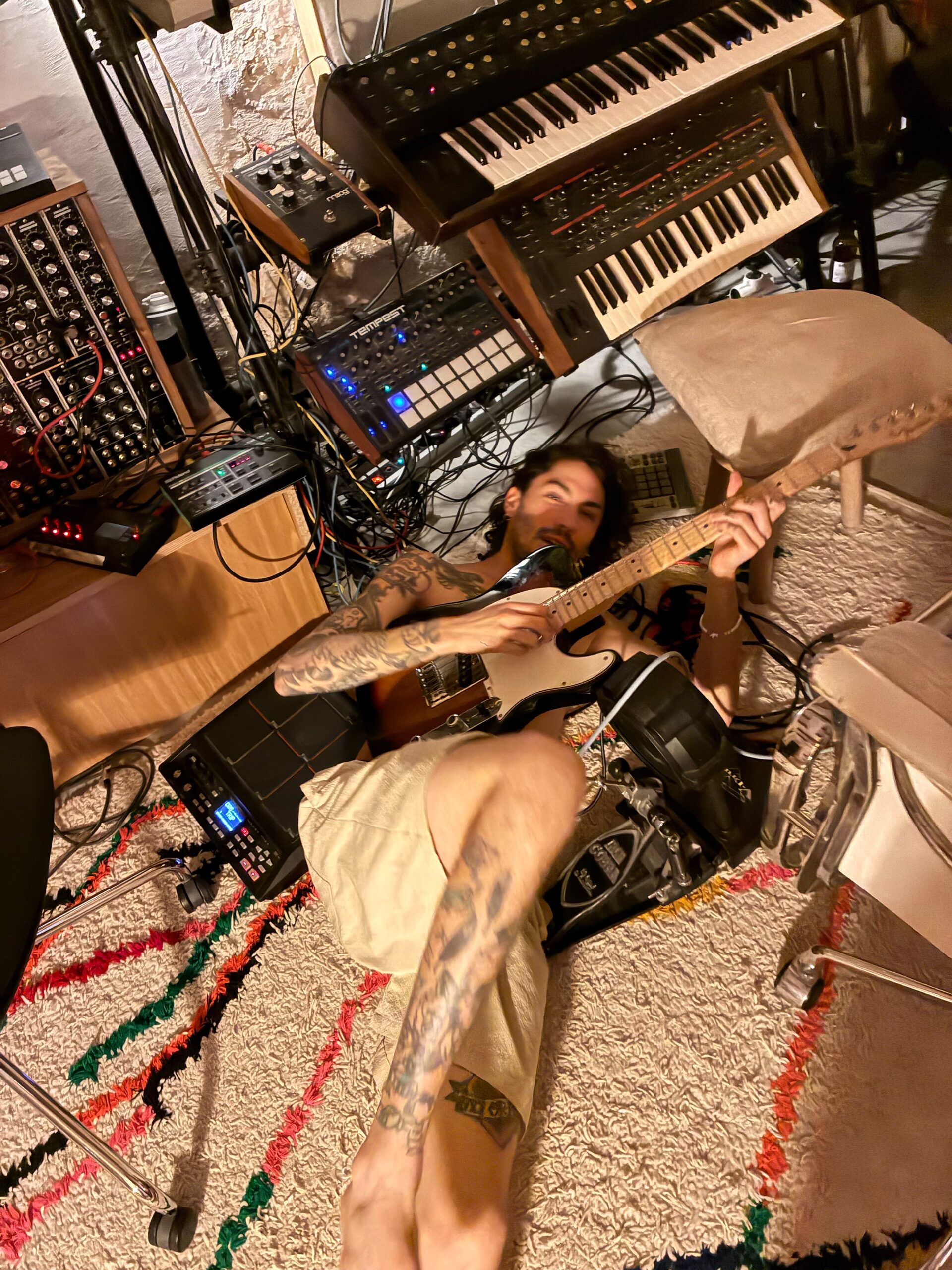
Clubs and electronic music has clearly been a huge part David’s life, but it club based music is not all that his only passion. With Triana y Hermana Juana, he fuses Colombian and Caribbean rhythms with jazz and funk, and we’re curious how that live-band world talks to his work behind the decks, “Yeah, it’s a very interesting one. As I mentioned in answer one, I think that everything is interconnected in my creative practices. Having the chance to explore myself as a DJ opened up so many more musical landscapes that I could then bring into my musicianship and my live playing.
As a musician, I’ve noticed that sometimes it can be very tricky because there tend to be two ways of approaching being a musician. One is an empirical approach, where you discover things on your own and, in a way, don’t care too much about an academic approach to it. And the other one is, per se, the academic approach. But the problem with following only one or the other is that you might lose out on either experimenting and finding things for yourself, or you might create too much structure and too many rules that can limit your creativity.”
He continues to give his thoughts on the educational side of music against the creative side, The academic or theoretical can seem too boring or complicated, while the experimental can become too free and without method, and this can lead you to hit the same wall over and over again. Loving the craftsmanship of digging and DJing taught me so much more about my love and my connection to sound and music. And that transformed me as a musician, as an artist and as a person.”
As pragmatic as ever, David has thoughts on how to handle this trade-off, “The best approach is always your personal connection to your ideas, and that’s why there isn’t one specific path you can follow. It’s a combination of all the things you are: the free, creative side and the construction of more complex mental structures — your intellect. So again, these things are really connected, and they feed each other constantly. As a musician, I get to explore and learn more about music because I am also a DJ, and I get to explore my mixing in a more musical way through my musicianship.”
As both a producer and a bandleader, it would seem that the approach to each project and its music would be totally different. We asked David to elaborate on the differences: “I would like to believe that a lot of the music that I write, regardless of whether it’s for the band or for the club, carries that dance DNA in it. Because one of the things that excites me the most as a creator is movement.
So obviously, one record might contain more acoustic elements than a house music record that I would produce, and naturally, you would approach certain things differently for each one. But it might be less different than one would think. Because one musical idea, or to be more precise, a melody or a feeling, can be expressed in so many different ways. And I really like that element of composing and arranging music: how you can transform the same thing into an abstract piece of music or a more structured dance piece of music… or anything.”
Having held residencies in cities as different as Bogotá, Madrid, Istanbul and London. We wanted to know how moving between those scenes has shaped his sound over the years, “Getting to play for different crowds and in different cultures definitely shapes your perspective as a performer. In the sense that, if you are open enough to want to connect with people when you play, you realise that each place has its own connection to music, and even to you as an artist, or to their perception of you as an artist.
What you can learn from this is to be sensitive enough to realise what it is in your music that people connect to the most on different dance floors and in different places. It makes you an artist who has a broader variety in their sound and in their bag. So it shaped me in the sense that it made me a broader artist and a more open-minded person towards what I considered to be my artistic language.”
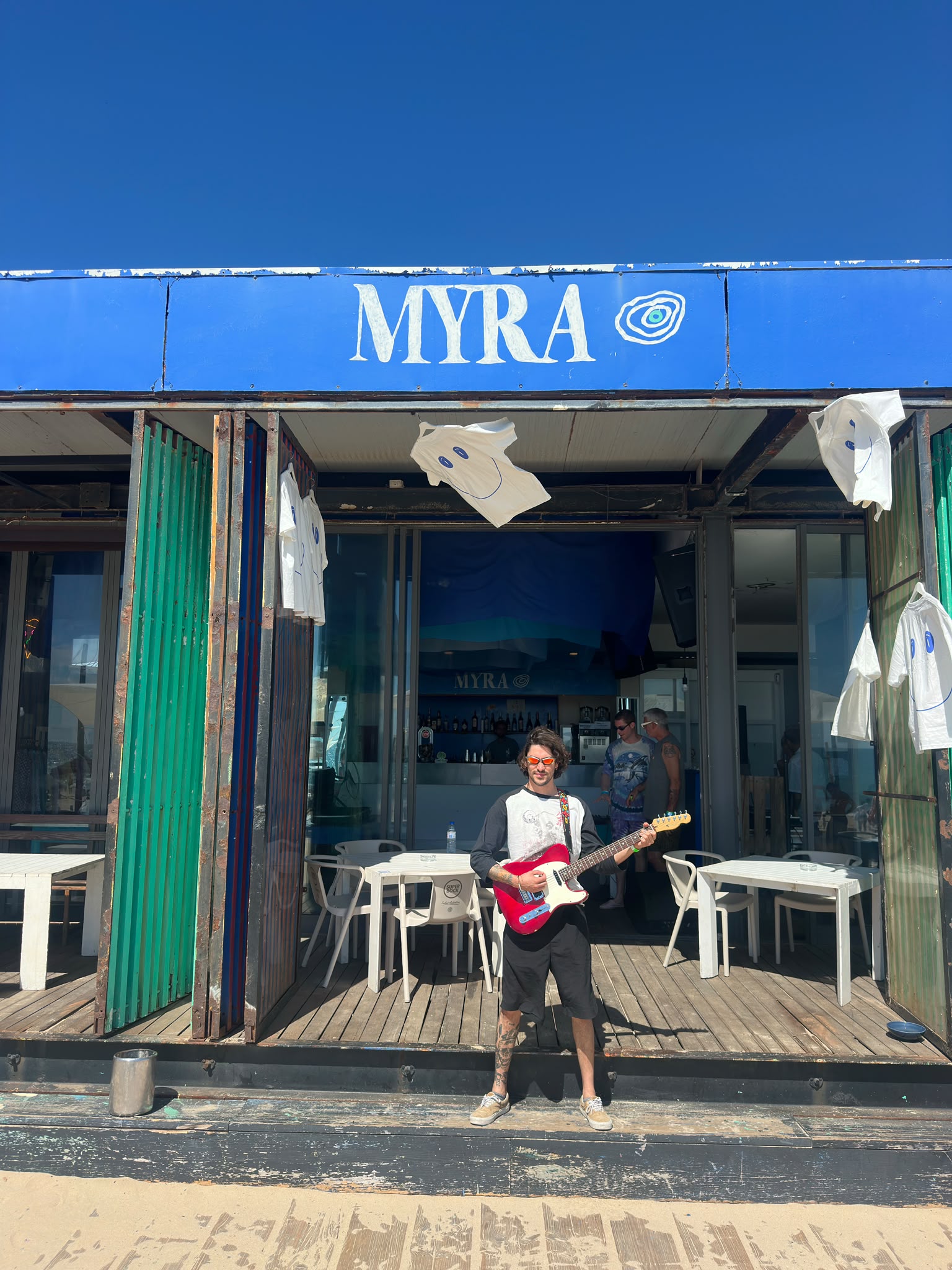
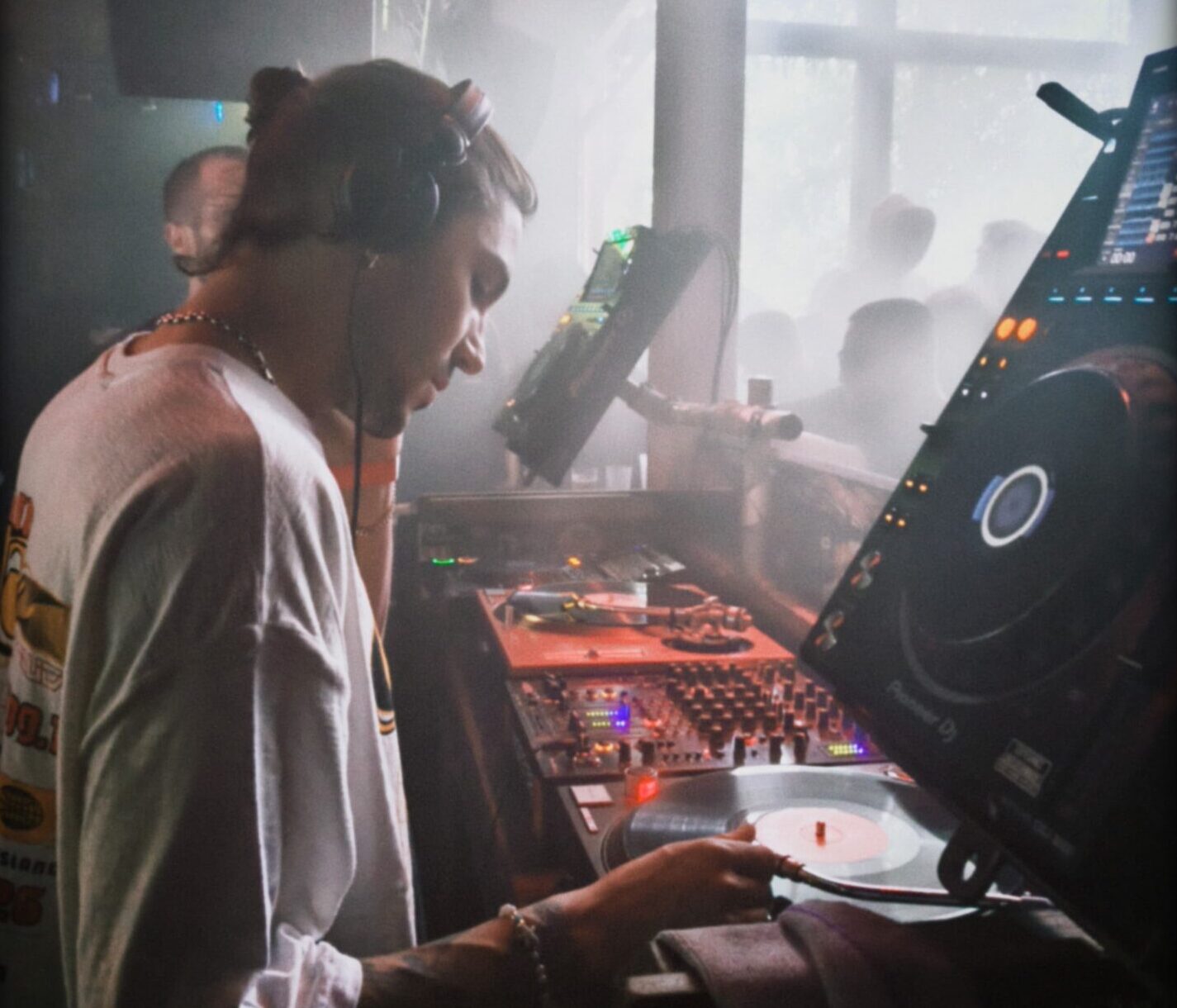
If you have been to a festival or underground party in the last few years, there is a high chance that you will have caught David Triana in action. Big clubs and smaller venues are very different rooms, and react to different energies. With this experience playing to different spaces, it was interesting to learn how David makes adjustments for the crowd and the space, “Well, it’s all about connecting with the crowd that is in front of you. Even though I love to have a bit of a plan before a specific gig, there’s always an element of surprise, both for the artist and the crowd.
It can be influenced by the mood of the night, how the sound system was calibrated, how many people are in the room, and so on. That can immediately change your approach to the set. That’s why I think a good DJ, a good performer, or even a musician has to always be open to reading and understanding what is in front of them.
Also, whatever you imagined it was going to be like, it always turns out to be something else. So there’s only so much you can prepare. You need to be prepared enough to be able to adapt to different situations.”
With a vivid picture being painted by David via his up-front and transparent stories and viewpoints, we round up our conversation in a very poignant and deep way. We pose the question “What does ‘home’ mean to you musically at this point?”, “It’s a very interesting question. For me, home recently is something that I carry with me, for sure, rather than a specific place. But I’ve been living in London for over a decade, and I think that this has definitely had a huge impact on my perception of music and of creating music, compared to if I had just stayed in Colombia all these years.
But then home is also something attached to your early memories and where you come from. And this is a concept that I like to defy, because as humans we tend to, in a way — and I say “in a way” because this is very much from my own point of view — identify with one thing: your culture, your country, your family, and so on. And this is an integral part of what makes us unique and what makes us who we are.
But when you get the chance to travel or connect with other cultures and traditions, and explore through them, that also becomes part of your life and your own culture. So I like to believe that my home has expanded from Colombia to Europe, and so on.
Music is a celebration of humanity. Therefore, yes, London for sure has become more of my home in a way, but musically it has just expanded what I love about music itself. It’s something universal. Music is the universal language that can speak to and make a person feel the same on an island in the Pacific Ocean as a person in Bogotá.”
More info on David Triana
Instagram | RA | Soundcloud | Discogs